Papi, the popular Men’s underwear brand, has recently shut down their standalone site and opted to move their business over exclusively to Amazon. When we look at their website we see:
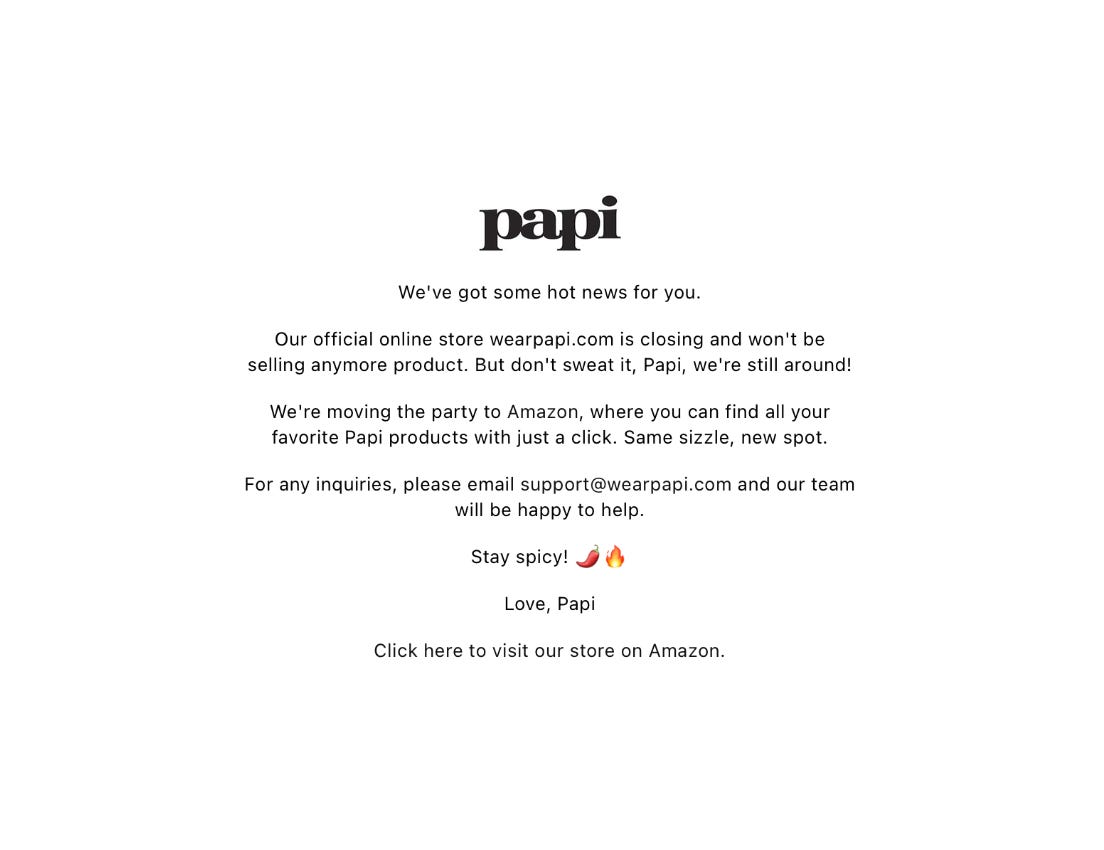
The message, which has replaced their store on their proprietary domain wearpapi.com , states their customers can still find their products available online, “Same sizzle, new spot”. That new spot is Amazon.
So what could have motivated such a move?
1. The CAC (Customer Acquisition Cost) Hedge
In 2026, the average DTC brand is losing roughly $29 on every new customer’s first purchase due to high ad spend on social platforms.
The Amazon Advantage: By moving to Amazon, Papi moves from “Demand Generation” (paying to find people) to “Demand Capture” (appearing when people search).
The Logic: Even with Amazon’s 15% referral fee and rising CPCs (averaging $1.04 to $1.50 in apparel), the conversion rate on Amazon is often 3x to 5x higher than a standalone site. This makes the “Total Cost of Sale” predictable and, in many cases, cheaper than the wild swings of Instagram ad auctions.
2. Logistics & Inventory “Liquidization”
Offloading logistics isn’t just about saving on postage; it’s about capital efficiency.
Variable vs. Fixed: Instead of paying for a warehouse lease each month and a full-time shipping team (Fixed Costs), Papi pays Amazon only when a product sells (Variable Costs).
Automated Scaling: With FBA, Papi can handle a 500% spike in orders during a holiday weekend without lifting a finger. Their independent site would have required hiring temp workers and dealing with manual shipping delays.
3. The “Tariff” Paradox
This is the most volatile piece of the puzzle right now. The tariff landscape shifted significantly in early 2026:
The “De Minimis” Suspension (Aug 2025): Earlier, the US suspended the “de minimis” exemption (which allowed small packages under $800 to enter duty-free). This effectively made shipping individual orders directly from overseas factories to US customers (the classic “dropshipping” or DTC model) much more expensive.
Why Amazon Wins Here: Since the “small package” loophole is closed, brands must ship in bulk (ocean freight). Amazon’s Global Logistics and FBA are built for bulk efficiency. They can handle the complex customs bonding and high-volume processing that a small independent brand would find administratively overwhelming.
Summary of the Strategic Pivot
Benefit
Independent DTC Model
Amazon Marketplace Model
CAC:
Pre-Amazon - Losing $29 per first sale; low retention.
Post-Amazon - High-intent traffic; higher conversion rates.
Logistics:
Pre-Amazon - Manual, fixed-cost, slow shipping.
Post-Amazon - Automated, variable-cost, Prime 1-day.
Tariffs:
Pre-Amazon - High admin burden on bulk imports.
Post-Amazon - Amazon Global Logistics manages the “mess.”
How Can We Apply This To Our Own Passive Income Businesses?
Selling digital products we luckily, and intelligently, get to bypass many of the issues physical product business have to endure, namely shipping logistics as well as tariff issues. However, we are not exempt from the rising cost of Advertising which is essential for scaling any digital products business.
We can apply the same strategy, utilizing marketplaces aggregate intent-based visitors, to make passive sales. For example, I sell courses where I teach my very own proprietary best methods for generating passive income, while I mainly use organic content based marketing as well as online advertising there is nothing stopping me from throwing my courses on sites like Udemy or Coursera and benefiting from their courses marketplace full of millions of monthly visitors looking for courses on my specific topics I teach.
I also sell vocals and beats online often utilizing Youtube as an organic marketing method (I tag the vocals and beats so they cannot be ripped or stolen), but I also benefit from selling directly via Beatstars rather than my own site because Beatstars has its own customer base and search algorithms that it uses to surface the best beats for any users search.
Apple’s App Store is another prime example, where many apps got their primary exposure and lift from simply posting to the Apple App Store and allowing the store’s algorithm (as well as built in virality mechanics) to do the hard work of getting more and more customers onto the app, especially at a near 0 cost.
And of course the benefit of marketplaces is the trust that is built in for the customers. They know there are policies in place to keep them from getting ripped off, marketplaces have customer service there to assist purchasers, and even the seller can trust that the marketplace itself will work versus the anxiety that something could go wrong or not work if someone were to say vibe-code their own store. Marketplaces offer ‘Enterprise-Grade’ stability. You don’t want your revenue stream depending on a ‘vibe-coded’ checkout page that might break during a traffic spike.
While Papi is forced to pay the ‘Amazon Tax’ to survive, digital creators have a distinct advantage. We use marketplaces like Udemy, Beatstars, or the App Store not as a last resort, but as a customer acquisition machine. We trade a percentage of the sale for a 0-cost lead. In my Marketplace to Passive Income course, I don’t just show you how to list a product; I show you how to engineer your offer so the marketplace’s algorithm is forced to promote you.
The $44 Strategy: Moving from Survival to Scale
Papi’s move to Amazon is a defensive masterstroke against a volatile 2026 economy. They are trading “brand ownership” for “margin survival.”
But as digital entrepreneurs, we have a unique advantage. We don’t have to choose. We can use these marketplace giants as Customer Acquisition Machines while keeping our margins at 100%.
I’ve spent years engineering the exact SEO and review-loop strategies I use to generate passive income from these platforms every single month. I’ve packaged the entire blueprint into my Marketplace to Passive Income Course.
For $44—roughly the cost of two pair of Papi briefs—you can learn how to stop chasing customers and start letting the world’s biggest search engines find them for you.
[Check out the Course Here]
To see my full portfolio of digital systems, visit Dimi Lowe Courses.