As we are all aware, the world is going through rapid changes as Ai continues to take over in business, consumer behavior, and overall the world.
The business of blogging has been most directly impacted by Ai since OpenAi released ChatGPT and therefore the proverbial Panadora’s Box. At first the ability for Chatgpt and similar LLMs that followed to make seemingly professional grade articles in an instant seemed to be an opportunity to turbocharge blogging businesses, but as years have passed and Ai has been more and more democratized the landscape for blogging businesses has shifted requiring business models to adapt.
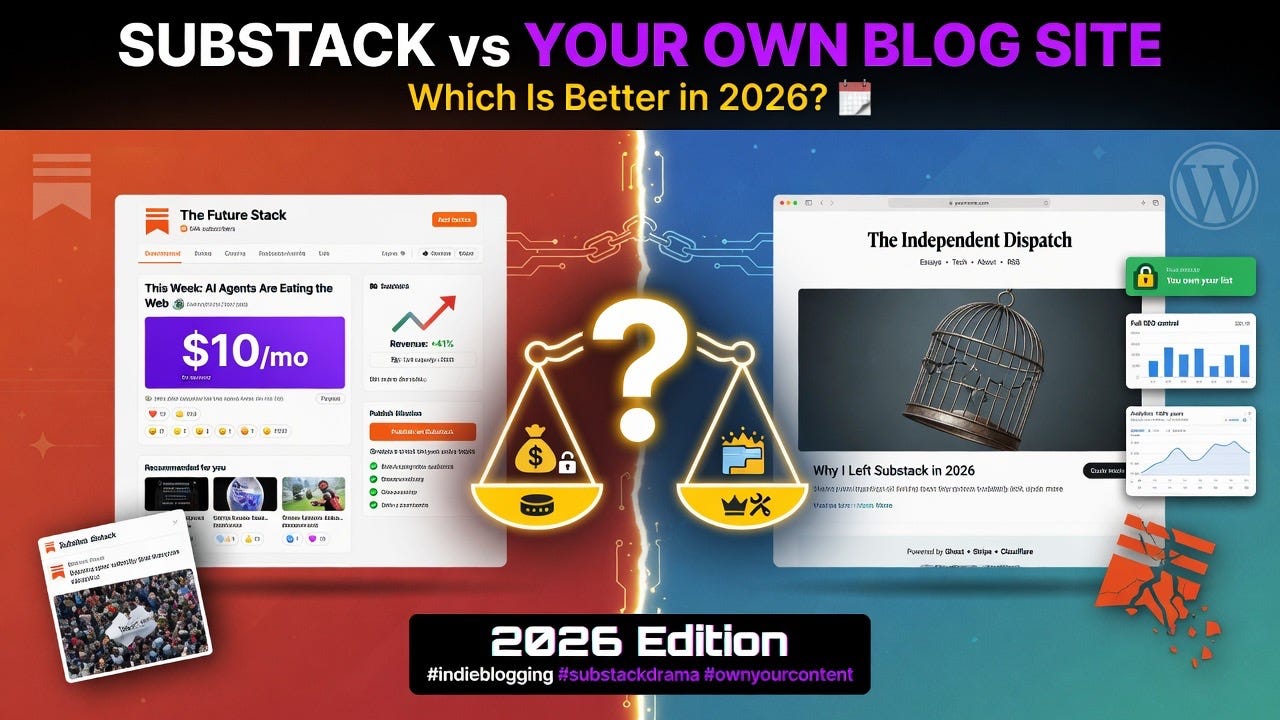
So, in the new age of blogging, which is better? Substack? Or having your very own Blog site?
As we take a deep dive into this question, first let’s frame the problem the advent of Ai and its resulting landscape has created for blogging based businesses.
The Issues:
Ai Slop Is Undesired
People get answers directly now decreasing their search for articles serving their intent
SEO no Longer Dominates
Video is still King
Ai is known to follow certain linguistic patterns that make it a dead giveaway that any sort of writing was written by a language model rather than an actual human. This seems to be a result of each models own training as the issue is pervasive across different sort of outputs, for instance the insanely popular music based LLM Suno suffers from the same problem. Blogs that lack a human in the loop instantly lose trust with the reader when the expectation is that the writer is human or at very least includes a human perspective.
Blogs as a business model run primarily on monetizing an audience or traffic they’ve been able to garner with their writing or articles. Oftentimes people had questions and would have to sift through articles or webpages on Google searches in order to find a relevant answer to their question. This behavior has changed as more and more people have adopted services like Google Gemini, ChatGPT, Claude, and even social media sites like Tik Tok and Youtube to search for answers. Without traffic to their blog sites because google has already answered the question with Ai prior to them clicking any links, blogs cannot make money.
A traditional blogging business model almost entirely relied on SEO. Blogs used to rank their webpages on google as people searched different keyword terms, and this essentially gave them free traffic, aka customers, to add to their readership. However, relying on SEO is becoming less and less reliable as consumer behavior continues to change. With fewer people landing on actual webpages and engaging with webpage based content, the opportunity for blogs to turn those previous readers into monetized customers becomes continuously more difficult.
As Google’s grip on search based intent of the entire internet slips, even ever so slightly, competitors have found a way to vie for marketshare of people searching for answers and things. During my time as a High School teacher, I have noticed students naturally opting for Tik Tok as their platform of choice when searching for product reviews or examples to show their friends. What was previously dominated by text, is now dominated by video which is arguably a better medium but requires blogs to adapt and build presence on platforms meant for video such as social media sites. This shift also makes businesses that previously operated from their own blog sites beholden to those social media platforms rules (or risk having their accounts banned), exasperating the need to turn “rented” traffic into ones’ own owned audience.
Now that we have a stark understanding of the changes that are bringing about the new blogging industry, let’s see which is the better business move for starting your own blog in 2026.
Substack
Substack is a “turnkey” platform designed to get writers up and running in minutes. It functions like a hybrid of a blog, a newsletter, and a social network.
Pros:
Frictionless Setup: You can go from zero to published in under an hour without touching a line of code or managing hosting.
Built-in Discovery: The “Substack Network” (recommendations and “Notes”) helps surface your content to other users on the platform, acting as a built-in marketing flywheel.
Seamless Monetization: It has a “one-click” subscription model. There’s no need to set up Stripe integrations or paywalls yourself.
Community Features: Native commenting and the ability for other writers to “recommend” your publication make it easier to build an initial audience.
Cons:
The “Success Tax”: Substack takes a 10% cut of your subscription revenue (on top of Stripe fees). As you scale toward higher revenue targets, this becomes significantly more expensive than a flat-fee hosting plan.
Limited Customization: You have very little control over design, CSS, or layout. Your brand will look very similar to every other publication on the platform.
Weak SEO: While it has basic SEO features, you cannot easily optimize technical metadata, control site architecture, or host it as a subdirectory of a larger tech project.
Platform Risk: You are building on “rented land.” While you can export your email list, you are subject to their terms of service, and any policy or algorithm changes can immediately impact your business.
Self-Hosted Blog / Website (WordPress, Ghost, Custom)
A self-hosted site is a digital asset you own entirely. You have “the deed” to the property and can build whatever you want on it.
Pros:
Complete Control & Ownership: You own the data, the code, and the platform. No third party can take a percentage of your revenue or change the rules of your business.
Scalable Monetization: Beyond simple subscriptions, you can easily integrate digital stores, affiliate links, display ads, or SaaS tools. You keep 100% of the profit (minus standard payment processing).
SEO Dominance: A dedicated site allows for deep technical SEO, including custom schema, faster load times, and better ranking for “evergreen” content that drives traffic for years.
Unlimited Extensibility: As a developer, you can build custom widgets, landing pages, or “self-liquidating offer” funnels directly into the site.
Cons:
Technical Overhead: You are responsible for maintenance, security updates, backups, and hosting.
Fragmented Workflow: Unlike Substack’s all-in-one system, you’ll likely need separate tools for your CMS (WordPress), email delivery (Kit/Mailchimp), and payment processing.
The “Cold Start” Problem: There is no built-in discovery. You must drive your own traffic through search engines, social media, or paid ads.
Comparison Summary
Feature
Substack
Self-Hosted Website
Cost
Substack - Free ($0 upfront), 10% revenue share
Self-Hosted Website - Monthly hosting + tool fees (Fixed)
Effort
Substack - Low (Plug-and-play)
Self-Hosted Website - Moderate to High (Maintenance required)
Ownership
Substack - Rented Land
Self-Hosted Website - Full Ownership
Growth
Substack - Internal recommendations & social
Self-Hosted Website - SEO & External marketing
Customization
Substack - Minimal (Standardized)
Self-Hosted Website - Infinite (Full design/code control)
The Verdict
The business of blogging still runs on monetizing readership. Depending on your chosen model, and which tradeoffs you are willing to make, either Substack or Your Own Blog may be the best bet for you. If you value growth, or are used to social media based mechanics and algorithms, Substack seems like a great way to jump start the reach of your writing. Once you build your own readership, migrating your audience or adding your own blogsite as another vertical where you have more control can allow you to customize your business to fit your needs exactly.
This is the strategy I use myself, Substack to charge my initial reach then as my audience grows migrating them to my own channels where I have full control. Substack is great for top of funnel, and will likely be continued to be used as exactly that, a pathway for finding new readership; but as an experienced business person I also know the importance of fully own your own audience and having your own channels you entirely control for reaching them.
So which is better? Our answer is Both.
Blogging is still a highly lucrative and high-leverage business that almost anyone can start in 2026. Check out our Blog To Passive Income Course, our very own best method for starting your own blogging business.
If you are interested in learning other passive income opportunities check out our store Dimi Lowe Courses which has all our very own best methods, all learned from trial and error and personal experience, for how to start building passive income online today.